-
Definitions and assessment of residual distal radioulnar joint instability after operative fixation of distal radius fractures: a methodological systematic review
-
Jae Ho Cho, Seungyeob Sakong, Sumin Lim
-
J Musculoskelet Trauma 2026;39(4):323-340. Published online October 19, 2026
-
DOI: https://doi.org/10.12671/jmt.2026.00290
-
-
 Abstract Abstract
 PDF PDF Supplementary Material Supplementary Material
- Background
Residual distal radioulnar joint (DRUJ) instability after operative fixation of distal radius fractures serves as an eligibility criterion, treatment indication, and outcome, but previous syntheses report inconsistent definitions. This methodological systematic review examined how clinical reports define, assess, and report it, and whether they distinguish it from structural triangular fibrocartilage complex (TFCC) lesions.
Methods
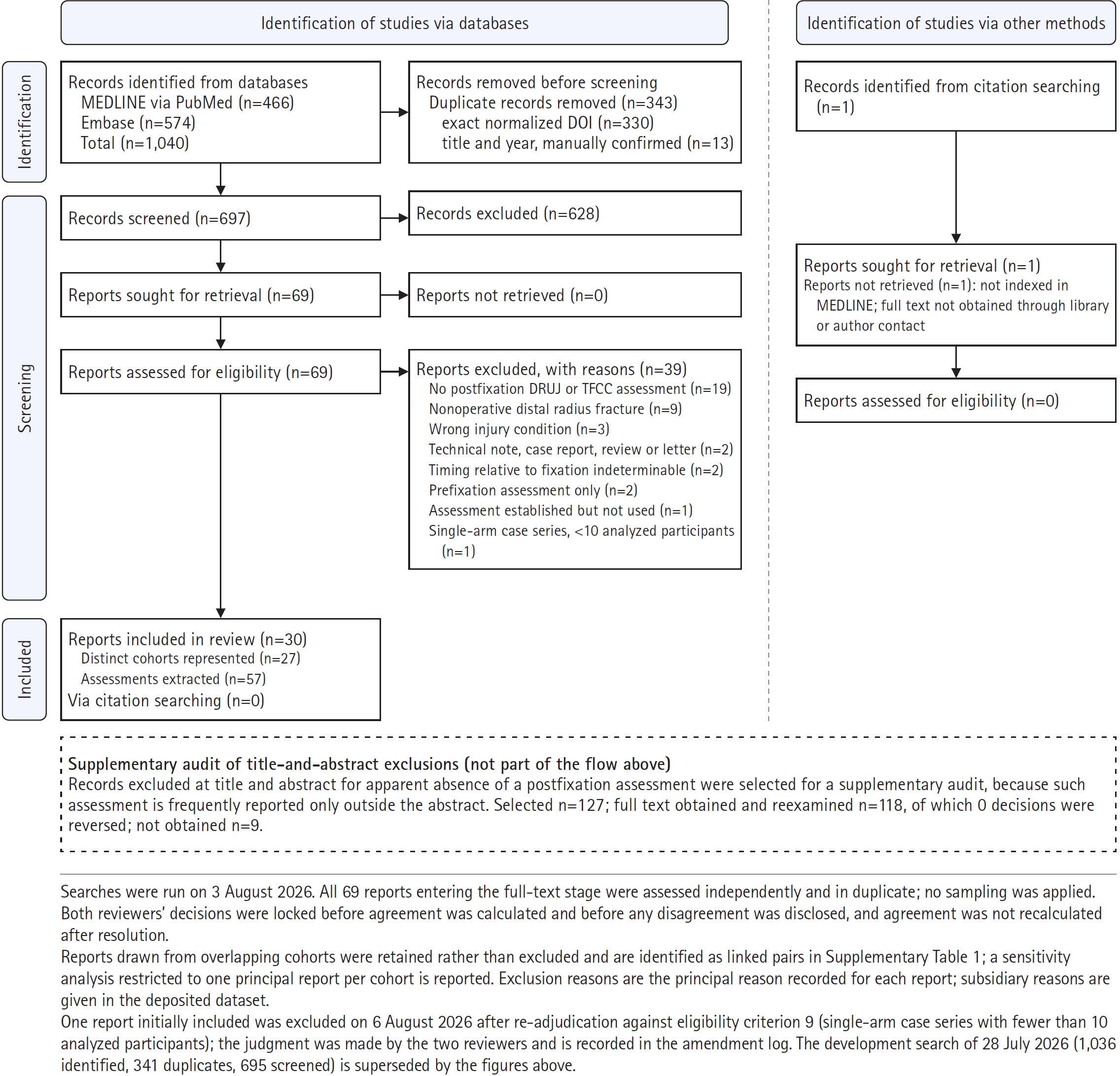
MEDLINE (PubMed) and Embase were searched from 2015 to 3 August 2026 for adult clinical reports in which residual DRUJ instability was assessed after fixation, or inferred from TFCC lesion characteristics, and used for a treatment decision or as an outcome. Every report entering full-text eligibility was assessed independently in duplicate; data were locked before agreement was calculated and disagreements disclosed. No riskof- bias tool was applied: neither treatment effects nor diagnostic accuracy were estimated. Findings are counts and proportions; no meta-analysis was performed.
Results
Of 1,040 records, 697 were screened and 69 assessed as full texts; 30 reports of 27 cohorts were included, contributing 57 assessments. In the treatment-decision context, 12 reports stated an operational definition (40.0% of all 30; 50.0% of the 24 containing such an assessment), four stated neither required element (16.7% of 24), and six contained no such assessment and were classified as not applicable. At the assessment level, the positive criterion was vague in 43.9% and absent in 17.5%, and explicit for 48.0% of intraoperative but 25.9% of final follow-up assessments. No report inferred instability from a TFCC lesion instead of testing the joint; one used the two constructs interchangeably, 14 (46.7%) distinguished them, and 15 (50.0%) addressed instability without structural verification. A comparable prevalence estimate was extractable from only 9 of 57 assessments (15.8%).
Conclusions
Residual DRUJ instability is therefore assessed frequently but is often incompletely defined, and until these elements are stated consistently, frequency estimates cannot be compared across studies.
Level of evidence: Not applicable.
-
How do we know a fracture has healed? A narrative review of radiographic bone union definitions and assessment methods
-
Jeong-Hyun Koh, Seungyeob Sakong
-
J Musculoskelet Trauma 2026;39(3):185-194. Published online May 20, 2026
-
DOI: https://doi.org/10.12671/jmt.2026.00150
-
-
Abstract
PDFSupplementary Material
- Bone union is the most commonly reported primary outcome in fracture treatment trials, yet no universally accepted radiographic definition exists. The widely taught criterion of “bridging callus on 3 of 4 cortices on anteroposterior and lateral radiographs” has no clearly identifiable primary source in the indexed literature. This narrative review traces the historical origins of radiographic bone union assessment, documents the heterogeneity of definitions used in clinical studies, and provides a comparative analysis of the standardized scoring systems developed to address this problem. A systematic PubMed search using six prespecified strategies, from database inception to March 2026, supplemented by hand-searching and citation tracking, identified 2,380 records. After screening, 359 articles on long-bone fractures were included. The “3 of 4 cortices” criterion appears most plausibly to derive from Panjabi’s 1985 finding that cortical continuity was the strongest radiographic predictor of fracture strength (r=0.80), but no traceable validation study was identified despite citation tracking through successive Cochrane reviews (CD008579, pub2‒pub4). In their 2008 study, Corrales and colleagues documented 11 different radiographic criteria across 123 studies, finding that ‘3 cortices’ was used in only 27%. Five standardized scoring systems (Radiographic Union Score for Tibial fractures [RUST], modified RUST [mRUST], Radiographic Union Score for Hip [RUSH], Radiographic Union Score for Humeral fractures [RUSHU], and Radiographic Humerus Union Measurement [RHUM]) have improved interobserver reliability within specific anatomical settings but remain fragmented by site and limited to secondary bone healing. A 2024 analysis by Bax et al. further illustrated that this inconsistency is not limited to fractures, documenting 13 different criteria and nine classification systems within the osteotomy literature. The most widely used radiographic union criterion likely emerged through clinical teaching rather than formal validation. A minimum reporting framework is proposed to improve standardization in future studies. Consensus definitions, cross-site validation, and more objective assessment strategies are needed to resolve this four-decade-old problem.
-
Definitive fixation for traumatic pelvic ring injuries: a dynamically informed, posterior-referenced framework
-
Jeong-Hyun Koh, Seungyeob Sakong
-
J Musculoskelet Trauma 2026;39(2):73-82. Published online March 24, 2026
-
DOI: https://doi.org/10.12671/jmt.2026.00045
-
-
Abstract
PDF
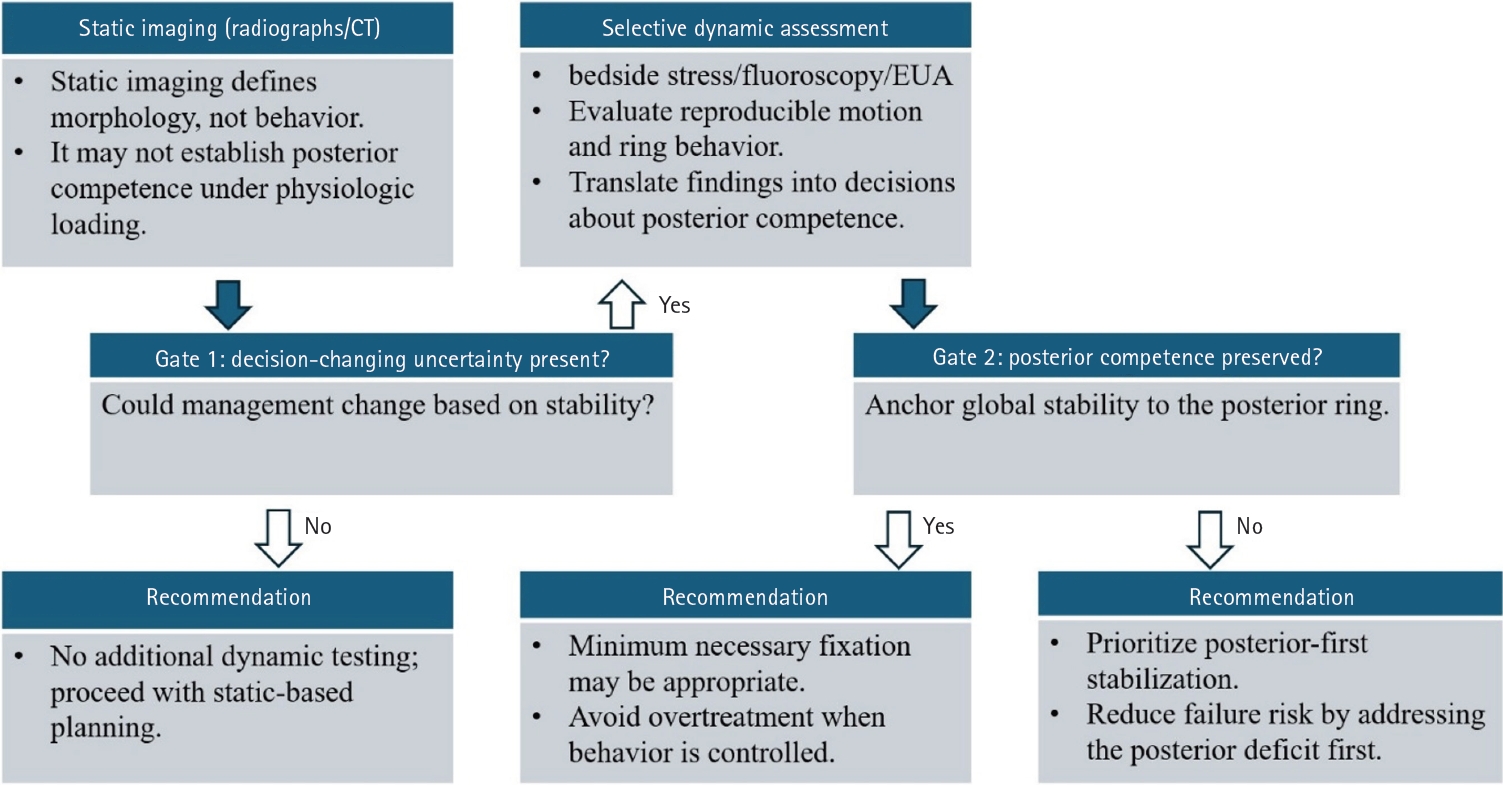
- Optimal definitive fixation for traumatic pelvic ring injuries remains challenging because static radiographs and computed tomography, although essential for defining morphology, do not consistently predict load-dependent behavior during early mobilization. This uncertainty contributes to substantial practice variation and continued reliance on simplified displacement thresholds, such as the 2.5 cm rule. Such rules can misclassify instability by underrepresenting posterior competence and by privileging static measurements over functional behavior. In this narrative review, we propose a dynamically informed, posterior- referenced framework composed of three linked elements: (1) decision-linked terminology that explicitly distinguishes dynamic instability, radiographic change, and clinical failure; (2) selective stress-based assessment when uncertainty is likely to alter management; and (3) escalation along a fixation continuum that weighs incremental stability against operative burden. When static imaging cannot establish posterior competence with confidence, we outline selective stress-based approaches to assess pelvic ring behavior and to translate demonstrated instability into fixation selection along a defined continuum. Across all steps, the framework emphasizes minimum necessary fixation and explicitly incorporates the cost of selection as a primary decision variable. The operative question, therefore, shifts from gap width alone to clinically relevant motion and preservation of posterior competence. In doing so, this approach aims to reduce both undertreatment and overtreatment and to improve the consistency and defensibility of definitive fixation strategies across diverse practice environments.
-
Combined acetabular and pelvic ring injuries: a reference-frame algorithm for definitive fixation sequencing
-
Jeong-Hyun Koh, Seungyeob Sakong
-
J Musculoskelet Trauma 2026;39(2):83-92. Published online April 9, 2026
-
DOI: https://doi.org/10.12671/jmt.2026.00031
-
-
Abstract
PDF
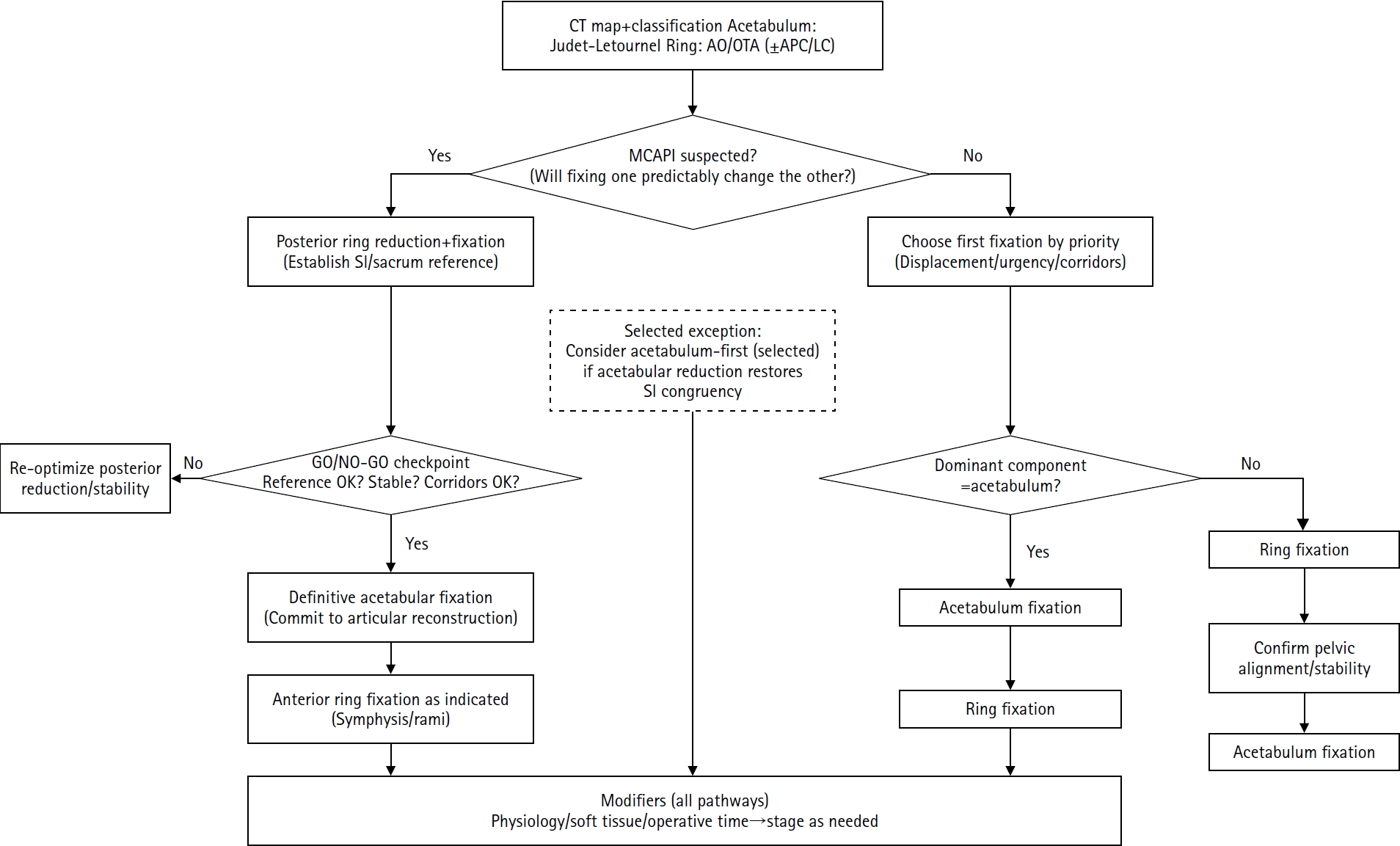
- Combined acetabular and pelvic ring injuries are not simply “two fractures in one patient.” Reduction and fixation of one component can alter the alignment and reducibility of the other, rendering operative sequencing a primary decision variable rather than a secondary consideration. These injuries typically result from high-energy trauma, frequently occur in patients with polytrauma, and are further influenced by physiological tolerance and the feasibility of available operative corridors. The existing evidence base remains constrained by retrospective study designs, inconsistent definitions, variable classification systems, and heterogeneous outcome reporting, all of which limit the strength of comparative recommendations. This state-of-the-art review presents a surgeon-facing, algorithmic approach grounded in a reference-frame mindset. We emphasize computed tomography (CT)-based mapping and the use of consistent terminology to characterize acetabular morphology, pelvic ring instability, deformity vectors, suspicion of mechanical coupling, and feasible operative corridors. Mechanically connected acetabular and pelvic ring injuries (MCAPI) are introduced as a working framework for identifying patterns in which reduction or fixation of one injury predictably influences the other. In cases of suspected MCAPI, a posterior ring-based sequence is generally preferred, typically consisting of posterior ring reduction and fixation, definitive acetabular reconstruction, and subsequent anterior ring fixation. We propose an explicit intraoperative “GO/NO-GO” checkpoint (reference acceptable, stable, corridors feasible) to prevent acetabular reconstruction on a moving target. Acetabulum-first strategies may be appropriate only in selected anteroposterior compression- type configurations in which acetabular fixation plausibly restores sacroiliac congruency and posterior stabilization remains technically feasible. We summarize key outcome domains and complication patterns, highlighting hip dislocation as an important risk factor associated with both neurologic deficits and overall complications. Standardized CTbased definitions and outcome instruments, together with multicenter cohorts employing predefined decision pathways, are required to test sequencing strategies and to determine whether improved radiographic reduction translates into durable functional benefit.
-
Citations
Citations to this article as recorded by  - Bicycle-Related Acetabular Fractures Are Associated with Anterior Column Involvement: A Multicenter Study with an Exploratory Analysis of Clipless Pedal Use
Bong-Ju Lee, Hwan-Hee Lee, Sung-Min Kim, Pichayut Wattanapreechanon, Se-Won Lee
Journal of Clinical Medicine.2026; 15(20): 7918. CrossRef
-
3,755
View
-
66
Download
-
1
Crossref
-
Treatment of avulsion fractures around the knee
-
Jeong-Hyun Koh, Hyung Keun Song, Won-Tae Cho, Seungyeob Sakong, Sumin Lim
-
J Musculoskelet Trauma 2025;38(2):63-73. Published online March 31, 2025
-
DOI: https://doi.org/10.12671/jmt.2025.00073
-
-
Abstract
PDF
- Avulsion fractures of the knee occur when tensile forces cause a bone fragment to separate at the site of soft tissue attachment. These injuries, which frequently affect adolescent athletes, can involve the cruciate and collateral ligaments, arcuate complex, iliotibial band, and patellar and quadriceps tendons. Radiographs aid in the initial diagnosis, while computed tomography and magnetic resonance imaging facilitate a comprehensive evaluation of injury severity and concomitant damage. Specific avulsion fracture types include: anterior cruciate ligament avulsions (tibial site, Meyers and McKeever classification), posterior cruciate ligament avulsions (tibial attachment, Griffith's classification), Segond fractures (anterolateral complex injury), iliotibial band avulsions, medial collateral ligament avulsions (reverse Segond, Stieda fractures), arcuate complex avulsions ("arcuate sign"), medial patellofemoral avulsions (patellar dislocations), and patellar/quadriceps tendon avulsions. The treatment depends on the fracture location, displacement, and associated injuries. Non-displaced fractures can be managed conservatively, while displaced fractures or those with instability require surgical reduction and fixation. Prompt recognition and appropriate intervention prevent complications such as deformity, nonunion, malunion, and residual instability. This review provides an overview of the pathogenesis, diagnosis, and management of knee avulsion fractures to guide clinical decision-making.
-
Citations
Citations to this article as recorded by - Avulsionsfrakturen am Kniegelenk – eine Übersicht
Anton Ferdinand Schmidt, Christoph Kittl, Adrian Deichsel, Larissa Eckl, Riccardo D’Ambrosi, Arasch Wafaisade, Josina Maiti Münchgesang, Jakob Ackermann, Dominic T. Mathis, Lukas Münch, Gergo Merkely, Lena Eggeling, Andreas Martin Seitz, Karl F. Schüttler
Arthroskopie.2026; 39(4): 255. CrossRef - Lateral marginal fractures of the patella and patellofemoral pain
Jae-Ang Sim, Chul-Ho Kim, Ji Wan Kim
Journal of Musculoskeletal Trauma.2025; 38(3): 152. CrossRef
-
50,107
View
-
351
Download
-
2
Crossref
-
Atypical femoral fractures: an update
-
Won-Tae Cho, Jeong-Hyun Koh, Seungyeob Sakong, Jung-Taek Kim
-
J Musculoskelet Trauma 2025;38(2):41-52. Published online March 28, 2025
-
DOI: https://doi.org/10.12671/jmt.2025.00031
-
-
Abstract
PDF
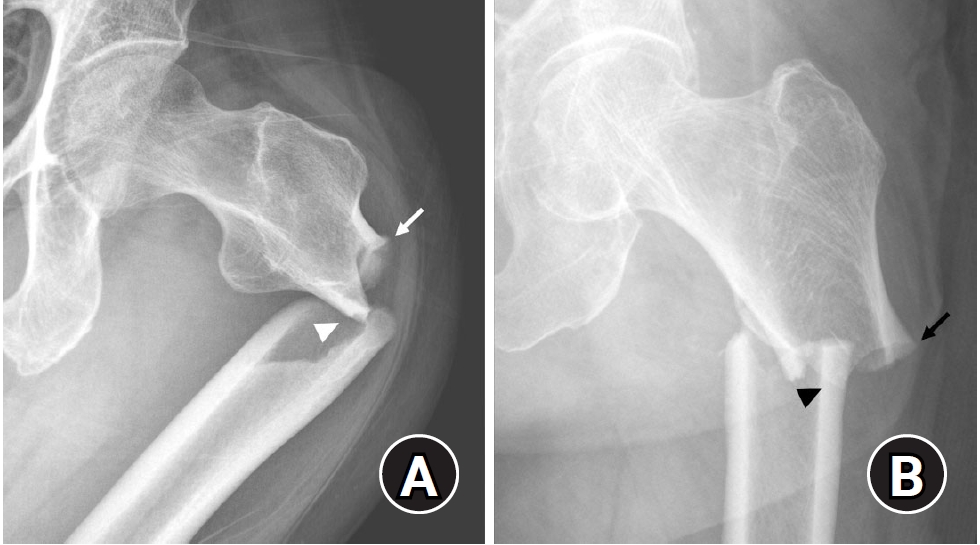
- This narrative review provides an up-to-date overview of atypical femoral fractures (AFFs), emphasizing diagnostic criteria, epidemiology, pathophysiology, risk factors, and evaluation with screening strategies. AFFs are rare but significant complications associated with prolonged bisphosphonate (BP) therapy for osteoporosis. Although the pathogenesis of AFFs has not been fully elucidated, its primary mechanism is thought to involve impaired bone remodeling, leading to unhealed microfractures that progress to stress fractures under repetitive loading. AFFs can occur in various regions of the femur, influenced by femoral geometry and the lower limb axis. Other risk factors include prolonged steroid use, arthroplasty, genetic predispositions, and metabolic bone disorders. The diagnosis of AFFs is based on criteria established by the American Society for Bone and Mineral Research. Key radiographic features include lateral cortical transverse fracture lines and localized cortical thickening, typically with minimal or no comminution on the medial cortex. Dual-energy X-ray absorptiometry for screening tests and magnetic resonance imaging as an advanced imaging modality enable the early detection of incomplete fractures. This multi-modal approach facilitates the prompt identification of prodromal cortical changes, reducing the risk of complete fractures in high-risk populations, particularly patients undergoing prolonged BP therapy.
Level of Evidence: V
-
Citations
Citations to this article as recorded by - Clinical Images: Bisphosphonate‐associated atypical femoral fracture with contralateral cortical beaking
Andreina Martinez Paulino, Valentin Marian
ACR Open Rheumatology.2026;[Epub] CrossRef - Atypical femoral fracture: The periprosthetic variant about two cases without bisphosphonate use
Guillaume Auberger, Thomas Aubert, Younes Kerroumi, Philippe Leclerc, Simon Marmor
SICOT-J.2026; 12: 41. CrossRef - Surgical strategies for atypical femoral fracture nonunion: Augmentative plating with or without exchange nailing
Do Hun Kim, Chul-Ho Kim, Ji Wan Kim
Journal of Orthopaedic Science.2026;[Epub] CrossRef - Atypical Femur Fractures Without Bisphosphonate Exposure (AFFwB): A Retrospective Report of 21 Cases
Lorenzo Lucchetta, Carmelinda Ruggiero, Samuele Berardi, Alice Franceschi, Michele Bisaccia, Giuseppe Rinonapoli
Journal of Clinical Medicine.2025; 15(1): 25. CrossRef
-
65,535
View
-
859
Download
-
4
Crossref
|

 E-submission
 KOTA
KOTA TOTA
TOTA TOTS
TOTS