E-submission
 KOTA
 TOTA
 TOTS

Articles
- Page Path
- HOME > > Volume 0; > Article
- Review Article Extracorporeal shockwave therapy for acute fractures: a narrative review of bone healing and soft-tissue recovery
-
Yonghyun Yoon1,2,3,*
 , Jihyo Hwang1,*, Jungyoun Kim1, Hyeongjik Kim3,4, Jonghyeok Lee3,5
-
DOI: https://doi.org/10.12671/jmt.2026.00262
Published online: September 14, 2026
1Department of Orthopedic Surgery, Gangnam Sacred Heart Hospital, Hallym University College of Medicine, Seoul, Korea
2Incheon Terminal Orthopedic Surgery Clinic, Incheon, Korea
3International Academy of Regenerative Medicine, Incheon, Korea
4Gurosamsung Top Orthopedic Clinic, Seoul, Korea
5Bareun Neurosurgery Clinic, Cheongju, Korea
Received: 2 August 2026 • Revised: 20 August 2026 • Accepted: 31 August 2026
- 0 Views
- 0 Download
- 0 Crossref
- 0 Scopus


Abstract
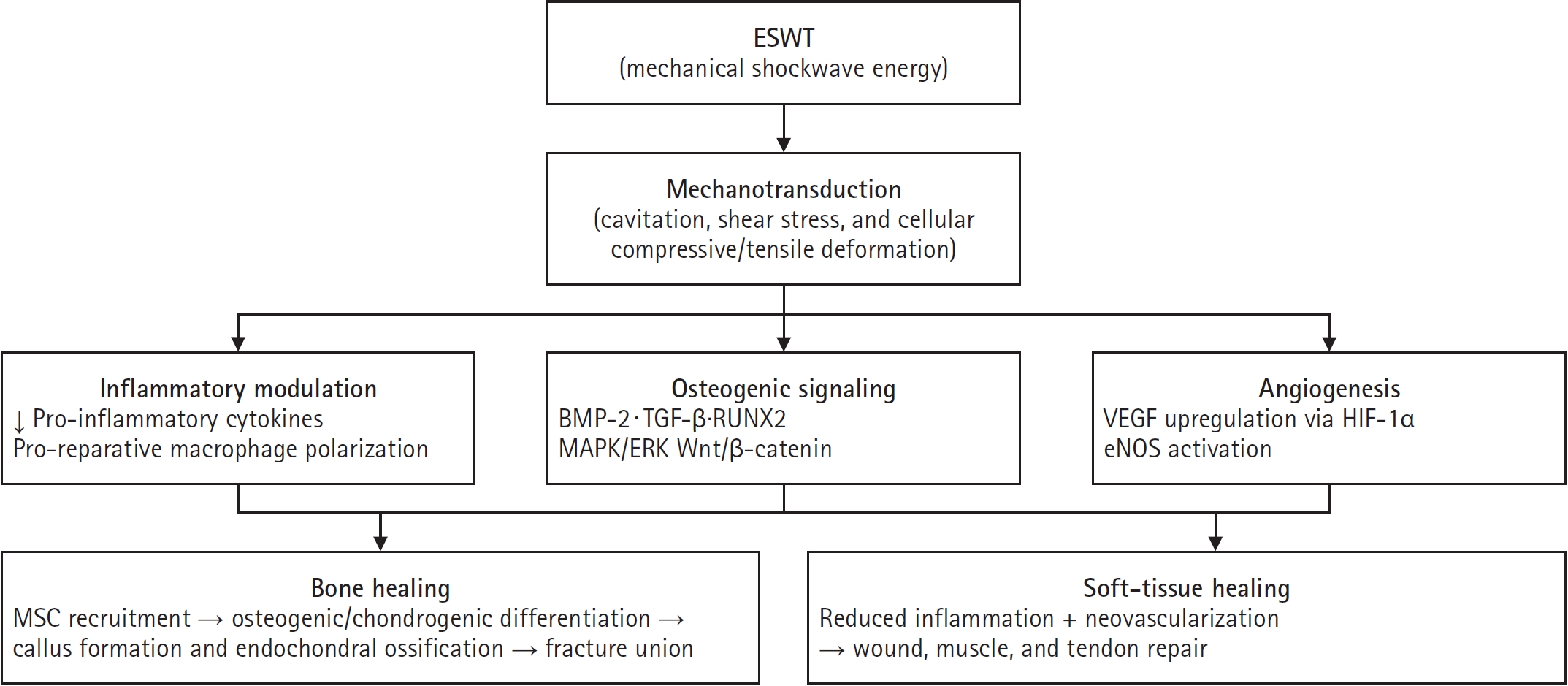
Extracorporeal shockwave therapy (ESWT) is well established for delayed union and nonunion of fractures, but its role in acute-fracture care remains comparatively underexplored. This narrative review synthesizes mechanistic, preclinical, and clinical evidence on ESWT for bone healing and soft-tissue recovery during the acute post-fracture period, including several studies published between 2023 and 2026 that have not previously been discussed together in a single review. ESWT may promote fracture repair through mechanotransduction-mediated activation of osteogenic signaling, including bone morphogenetic protein-2, transforming growth factor-beta, and runt-related transcription factor 2; angiogenic signaling mediated by vascular endothelial growth factor; modulation of the inflammatory phase; and acceleration of endochondral ossification. Human clinical evidence remains limited to a small number of trials, most notably a 56-patient quasi-randomized controlled trial that suggested a lower risk of nonunion, although the estimate was imprecise. The 2023 Cochrane Review rated the certainty of evidence as very low, and a 2026 systematic review similarly emphasized limitations related to small sample sizes and heterogeneous protocols. Evidence for acute soft-tissue and muscle injury is comparatively more developed and has been extended by a 2023 systematic review of muscle injuries, a 2021 case series on return to play in elite athletes, and a 2025 randomized controlled trial evaluating ESWT for periarticular soft-tissue injury after hip fracture surgery. Open fractures, in which bone and soft-tissue healing are biologically interdependent, represent the strongest candidate indication for future dual-outcome research. Adequately powered randomized trials using standardized protocols remain the principal unmet need before ESWT can be recommended for routine use in acute fractures.

 Cite