
 E-submission
 KOTA
KOTA TOTA
TOTA TOTS
TOTS
Search
- Page Path
- HOME > Search
Original Articles
- Percutaneous Kirschner-wire fixation followed by an opencast to permit protected daily and sports activities in patients with tendinous mallet finger: a case series at a tertiary hospital in Korea
- Hyeon Jun Kim, Ji Woong Kim, Min Kyun Cho, Sung Yoon Jung
- J Musculoskelet Trauma 2026;39(4):354-364. Published online October 20, 2026
- DOI: https://doi.org/10.12671/jmt.2026.00269
-
 Abstract
 PDF
PDF - Background
Dong-A University Hospital’s protocol for tendinous mallet finger requires 12 weeks of continuous full-time distal interphalangeal (DIP) joint splinting, which may restrict activities and complicate hygiene. This study evaluated the feasibility, short-term safety, and 6-month clinical outcomes of buried Kirschner-wire fixation followed by opencast application.
Methods
This retrospective case series screened 36 patients with mallet finger between January 2024 and October 2025. Twelve met the exclusion criteria, leaving 24 eligible patients; eight elected nonoperative treatment, and 16 chose surgery for acute closed tendinous mallet finger and constituted the study cohort. The DIP joint was fixed in approximately 15° of hyperextension using one or two buried 1.1-mm Kirschner wires. An opencast was applied at 1 week. The wires were routinely removed and active motion was initiated at 8 weeks, followed by a removable brace during outdoor or sports activities for 4 weeks. Outcomes were evaluated at 6 months.
Results
The mean preoperative extension lag was 30.0°. At 6 months, the mean residual extension lag was 1.9°, no flexion loss was observed, and Crawford outcomes were excellent in 62.5% and good in 37.5%. Two superficial pin-site infections resolved with oral antibiotics and local wound care. A separate case of wire loosening with painful subcutaneous prominence was managed with an aluminum splint. All patients resumed daily activities and showering at 1 week, when protected sports were also permitted; exact return dates and activity intensity were not recorded.
Conclusions
Buried Kirschner-wire fixation followed by opencast application may be an option for selected patients who wish to avoid prolonged full-time splinting. The protocol permitted protected activities from week 1 and active DIP motion from week 8; these findings support its feasibility but do not establish earlier return to unrestricted activity. Level of evidence: IV.
- 93 View
- 2 Download

- Three-dimensional computed tomography-based differentiation of engaged versus displaced intertrochanteric fractures using the anterior fracture line: a cross-sectional study from Korea
- Jae-Suk Chang, Jin Yeob Park, Sang-Ok Chun, Chul-Ho Kim
- J Musculoskelet Trauma 2026;39(1):30-37. Published online January 25, 2026
- DOI: https://doi.org/10.12671/jmt.2025.00318
-
Abstract
PDF
- Background
With the advent of an aging society, osteoporotic fractures—particularly hip fractures—are increasing, with a 1-year mortality rate of 17%. Achieving stable fixation that enables early ambulation is essential but remains challenging because complex intertrochanteric (IT) fracture patterns are often underestimated on plain radiographs. Using three-dimensional computed tomography (3D-CT), this study analyzed whether the anterior fracture line lies medial or lateral to the IT line and examined its relationship with displacement or distal medullary canal engagement, highlighting the potential influence of the joint capsule and capsular ligaments on fracture morphology and fixation stability.
Methods
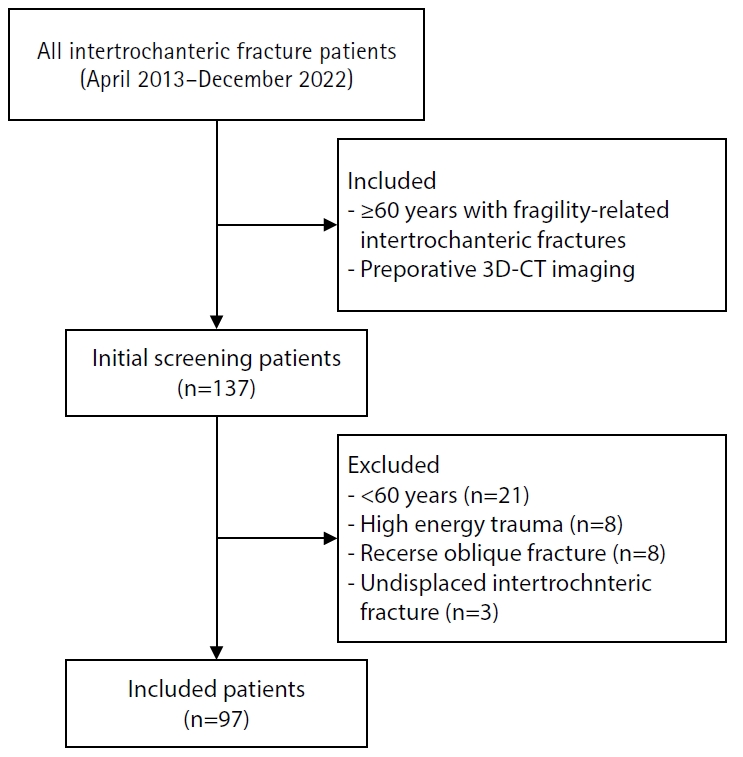
A retrospective review was conducted on 96 osteoporotic IT fractures in patients aged ≥60 years treated between April 2013 and December 2022 at National Police Hospital and Asan Medical Center, Seoul, Korea. Fractures were classified as engaged, completely displaced, and partially displaced based on 3D-CT findings. The anterior fracture-line position (medial or lateral to the IT line) and the status of the lesser trochanter (LT) were evaluated. The chi-square or Fisher exact test was used for statistical comparisons.
Results
In total, 96 patients were analyzed. Of these, 49 cases (51.0%) were classified as engaged type, 27 cases (28.1%) as completely displaced type, and 20 cases (20.8%) as partially displaced type. When comparing fracture pattern with anterior fracture-line position, the completely displaced type showed a significantly higher proportion of lateral anterior fracture lines than the other two types (P<0.001). However, no significant association was identified between fracture pattern and LT displacement. When the anterior fracture-line position and LT displacement were evaluated together, only the engaged type demonstrated a possible association between a lateral anterior fracture line and LT displacement, though the statistical significance was weak (P=0.047).
Conclusions
Fracture lines lateral to the IT line were strongly associated with displacement in IT fractures; however, their relationship with LT involvement, reflecting iliopsoas tendon traction, was not clearly demonstrated. Although the factors contributing to the engaged-type fracture remain uncertain, the statistical association between fracture pattern and anterior fracture-line position suggests that capsular structures may play a stabilizing role in select fracture configurations. Further studies are needed to clarify these anatomical interactions. Level of evidence:
- 1,831 View
- 26 Download
- The Acute surgical Treatment in Superior Peroneal Retinacular Injury in Ankle
- Suk Goo Han, Nam Yong Choi, In Tak Choo, Sung Jin Park, Young Mok Kang, In Ju Lee
- J Korean Soc Fract 1998;11(3):605-610. Published online July 31, 1998
- DOI: https://doi.org/10.12671/jksf.1998.11.3.605
-
Abstract
PDF
- The superior peroneal retinacular injury in ankle is often diagnosed as an ankle sprain and treated conservatively because of normal bony contour in type 1,2 injury according to Eckery's classification and small bony fragment with early union, evenly displaced in type 3. But its complications such as peroneal tendinitis and recurrent subluxation or dislocation of peroneal tendons sometimes develop late. Compared to peroneal tendinitis, the surgical treatment method for recurrent subluxation or dislocation of peroneal tendons is known superor to conservative method in results. And many reconstructive methods have been reported. In spite of their good results, harmfulness to normal structures, recurrences and technical difficulties may be a problem. So we perfomed 10 cases of acute surgical repair in superior peroneal retinacular injuries in ankle from March 1993 to February 1997 and prospectively analysed their clinical and radiological results with complications. Preoperative radiological diagnosis was done by plain films, peroneal tenography with computed tomography and also postperatively evaluated with plain films and peroneal tenography. 1. The most common cause of injury was sports(6 cases) including ski injury(4 cases) and average age of the patient was 29(17-56) years. 2. 4 cases of bony avulsion(type 3) were fixed with mini-screws and mean duration of bony union was 3.6 months. 3. The incidental subluxation or dislocation of peroneal tendons was not found intraoperatively and postoperatively. 4. All patients are able to participate in active exercise postoperatively except one patient who complains of lateral ankle discomfort due to peroneal tendinitis. In conclusion, acute surgical repair of superior peroneal retinacular injury in ankle is a recommended method to prevent it's complications such as peroneal retinacular injury in ankle is a recommended method to prevent it's complications such as peroneal tendinitis and subluxation or dislocation of peroneal tendons especially, in young and active patients.
- 779 View
- 0 Download
 First
First Prev
Prev


