
 E-submission
 KOTA
KOTA TOTA
TOTA TOTS
TOTS
Search
- Page Path
- HOME > Search
Review Article
- Minimally invasive plate osteosynthesis of the clavicle and humerus: indications, surgical techniques, and clinical outcomes
- Hoon-Sang Sohn, Yunjong Choi, Sang-Jin Shin
- Received May 24, 2026 Accepted June 29, 2026 Published online August 21, 2026
- DOI: https://doi.org/10.12671/jmt.2026.00220 [Epub ahead of print]
-
 Abstract
 PDF
PDF - Minimally invasive plate osteosynthesis (MIPO) is an established strategy for lower-extremity fractures because it preserves periosteal vascularity, maintains fracture hematoma, and promotes secondary bone healing through relative stability. Its use has expanded to fractures around the shoulder girdle, including fractures of the clavicle, proximal humerus, humeral shaft, and distal humerus. However, adoption in the upper extremity has been more cautious because of complex regional anatomy, narrow soft-tissue corridors, and the proximity of major neurovascular structures. This review summarizes current evidence on the indications, surgical techniques, clinical outcomes, and complications of MIPO for clavicle and humerus fractures. For clavicle fractures, MIPO is most commonly indicated for displaced multifragmentary midshaft fractures and provides union rates and functional outcomes comparable to those of conventional open reduction and internal fixation, with potential advantages in soft-tissue preservation and cosmesis. In proximal humerus fractures, MIPO performed through a deltoid-splitting approach has yielded favorable outcomes in selected two- and three-part fractures, whereas four-part fractures have less predictable outcomes and higher complication rates. In humeral shaft fractures, anterior MIPO provides stable fixation without routine radial nerve exploration and has shown reliable union with fewer complications in selected fracture patterns. For extra-articular distal humerus fractures, minimally invasive anterior and posterior plating techniques, including the use of an inverted proximal humeral internal locking system plate, have shown favorable clinical and radiographic outcomes despite technical challenges related to limited distal fixation. Overall, MIPO can achieve high union rates and satisfactory functional outcomes in clavicular and humeral fractures when indications are appropriate, safe anatomical corridors are respected, and surgical technique is meticulous.
- 418 View
- 9 Download

Original Articles
- Clinical and radiographic outcomes of elastic stable intramedullary nailing for pediatric humeral shaft fractures: a retrospective case series
- Kang-San Lee, Dongju Shin, Sang Hee Kim, Il Seo, Tae-Hoon Kim, Sung Jung Kim
- J Musculoskelet Trauma 2026;39(2):156-161. Published online March 10, 2026
- DOI: https://doi.org/10.12671/jmt.2025.00381
-
Abstract
PDF
- Background
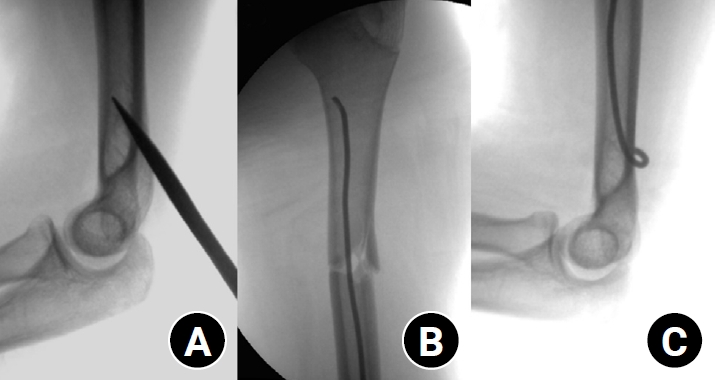
Pediatric humeral shaft fractures are uncommon and are generally treated conservatively, with satisfactory clinical outcomes reported in most cases. However, conservative management often necessitates prolonged immobilization and frequent outpatient follow-up visits, and it carries an inherent risk of residual angular or translational deformity. Elastic stable intramedullary nailing (ESIN) provides a simple and minimally invasive method of fracture fixation that offers adequate stability without disrupting the periosteal blood supply, thereby permitting early mobilization and promoting rapid bone union. The purpose of this study was to evaluate the clinical and radiological outcomes of ESIN fixation in pediatric patients with humeral shaft fractures.
Methods
The medical records of pediatric patients with humeral shaft fractures who underwent ESIN fixation between January 2015 and November 2025 were retrospectively reviewed. Data collected included patient demographics, mechanism of injury, fracture location, number of elastic nails used, time to union, degree of residual angulation, range of motion (ROM), and postoperative complications.
Results
The mean age of the patients was 10.0 years (range, 7 to 15 years). The mean time to radiographic union was 5.4 weeks (range, 2.4 to 10.4 weeks). The mean coronal angulation was 0.2° (range, −9.1° to 5.8°), while the mean sagittal angulation was −1.3° (range, −6.9° to 5.3°). No cases of infection, nerve injury, or nail migration were observed during the follow-up period. At the final follow-up assessment, all patients demonstrated full shoulder and elbow ROM, with no residual deformity or pain reported.
Conclusions
In this small retrospective case series, ESIN fixation resulted in favorable union rates and excellent functional outcomes in pediatric humeral shaft fractures. Level of evidence: IV.
- 834 View
- 26 Download
- Treatment of the Proximal Humeral Fractures
- Se Il Suk, Sang Hoon Lee, In Joon Kim, Min Jong Park
- J Korean Soc Fract 1989;2(1):1-8. Published online June 30, 1989
- DOI: https://doi.org/10.12671/jksf.1989.2.1.1
-
Abstract
PDF
- Thirty-four patients with proximal humeral fratures were treated at department of orthopedic surgery, college of medicine, Seoul National University between 1978 and March, 19 99. They were followed up between six months and three and half years with average of 1.2 years. Mean age was 52.9 years and traffic accidents was the most common cause of injury. According to the Neers classification, there were seven one-part(20%), sixteen two-part(48%), seven three-part(20%) and four four-part(12%) fractures or fracture-dislocations. The methods of treatment and its results were analyzed according to the Neers classificatioin and they were summarized as follows; 1. Seven one-part fractures were treated conservatively and showed satisfactory results in all. 2. Sixteen two-part fractures were treated conservatively except tow old cases and showed satisfactory results except one. 3. Seven three-part fractures were tried to be reduced by closed means but unacceptable five cases were treated by open reduction. They showed satisfactory results except one. 4. Four four-part fractures were treated by open reduction in two, by prosthesis in headsplitting and severely comminuted cases. They showed satisfactory results except one.
- 845 View
- 0 Download
 First
First Prev
Prev


