-
Paradoxical hypertrophy as a cause of femoral insufficiency fractures analyzed through differences in force application in Korea: three case reports
-
Yong-Uk Kwon, Dae-Hyun Park, Hyoung-Gu Kang
-
J Musculoskelet Trauma 2026;39(2):174-180. Published online April 23, 2026
-
DOI: https://doi.org/10.12671/jmt.2025.00388
-
-
 Abstract Abstract
 PDF PDF
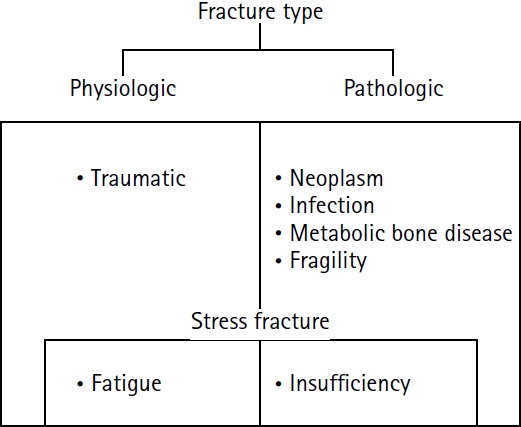
- Previous studies have extensively examined the association between femoral insufficiency fractures and prolonged bisphosphonate therapy. However, alternative etiologies remain insufficiently characterized. This study aimed to analyze nonpharmacologic factors associated with femoral insufficiency fractures, with particular emphasis on paradoxical cortical hypertrophy and altered biomechanical load distribution. We reviewed three cases of femoral insufficiency fracture that were surgically treated at our institution between January 2018 and January 2022. None of the patients had a history of bisphosphonate use. Clinical histories—including underlying comorbidities, prior surgical procedures, and radiographic findings—were evaluated. Serial radiographs obtained before and after fracture occurrence were analyzed to characterize fracture morphology and associated cortical changes. Case 1 involved a patient with posttraumatic hip synostosis; case 2 involved a patient with osteogenesis imperfecta; and case 3 involved a patient who had previously undergone intramedullary nailing for an intertrochanteric fracture. Lateral femoral bowing and cortical hypertrophy preceded fracture development in two cases, whereas focal cortical hypertrophy at the distal locking screw site was observed in the third case. No history of bisphosphonate therapy was identified in any patient. Fractures developed at sites characterized by increased cortical remodeling and abnormal load concentration. Femoral insufficiency fractures can occur in the absence of bisphosphonate therapy. Paradoxical cortical hypertrophy and altered biomechanical force distribution appear to be important contributing factors.
Level of evidence: IV.
-
Association between decreased bone mineral density and Pauwels angle in femoral neck fractures: a cross-sectional study
-
Soo-Hwan Jung, Yong-Uk Kwon, Ji-Hun Park
-
J Musculoskelet Trauma 2026;39(1):20-29. Published online January 25, 2026
-
DOI: https://doi.org/10.12671/jmt.2025.00269
-
-
Abstract
PDF
 Supplementary Material Supplementary Material
- Background
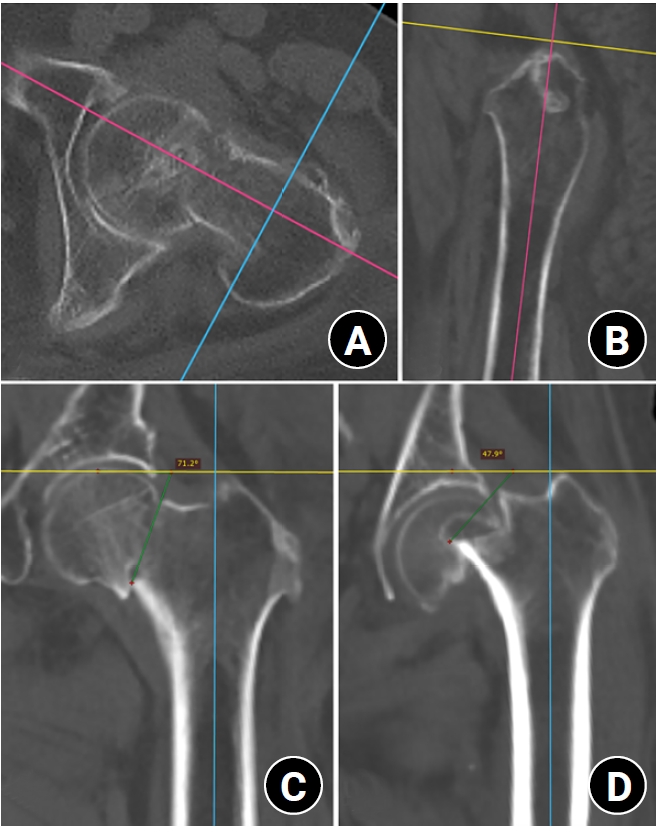
Progressive osteoporosis reduces the trabecular structures of the proximal femur, whereas the primary compression trabeculae (PCTs) are relatively preserved. We hypothesize that the loss of the vertically oriented PCTs in osteoporosis, which act as a mechanical barrier, affects fracture line propagation and influences the Pauwels angle. This study investigated the association between bone mineral density (BMD) and Pauwels angles in low-energy femoral neck fractures (FNFs).
Methods
This cross-sectional study included 150 patients (mean age, 75.3 years; range, 50–94 years) diagnosed with intracapsular FNFs between May 2019 and May 2023. BMD was measured within 1 month of the injury date using dual-energy X-ray absorptiometry, and modified Pauwels angles were assessed using a computed tomography-based multiplanar reconstruction program. Multiple linear regression analysis was performed to evaluate the factors influencing the Pauwels angles. The dependent variable was the Pauwels angle, while the independent variables included sex, age, height, body weight, body mass index, American Society of Anesthesiologists score, Charlson comorbidity index score, smoking status, alcohol use, preinjury walking ability, and femoral neck BMD T-scores.
Results
Higher femoral neck BMD T-scores were significantly associated with increased Pauwels angles (β=3.449, P<0.001). Greater body weight was independently associated with increased Pauwels angles (β=0.213, P=0.007).
Conclusions
The Pauwels angle demonstrated a significant association with BMD, with lower BMD associated with less steep Pauwels angles. In the absence of BMD measurement, the Pauwels angle may indicate osteoporosis severity in patients with low-energy FNFs.
Level of evidence: III.
-
Operative Positioning Technique for an Intertrochanteric Fracture in a Patient with an Ipsilateral Above-the-Knee Amputation - Technical Note -
-
Dae-Hyun Park, Yong-Uk Kwon, Dong-Seok Kim
-
J Korean Fract Soc 2021;34(4):137-141. Published online October 31, 2021
-
DOI: https://doi.org/10.12671/jkfs.2021.34.4.137
-
-
Abstract
PDF
- A 45-year-old man with a remote history of a left above-the-knee amputation presented to the emergency department with left hip pain after a mechanical fall. This case was an operative challenge because commonly used intraoperative traction methods could not be applied to a patient with an above-the-knee amputation. We describe a rarely utilized surgical technique of applying traction to an amputated extremity via a Steinmann pin during closed reduction and internal fixation of an intertrochanteric fracture.
-
Citations
Citations to this article as recorded by  - Periprosthetic Femur Fractures in Osseointegration Amputees
Jason Shih Hoellwarth, S. Robert Rozbruch
JBJS Case Connector.2022;[Epub] CrossRef
-
1,758
View
-
9
Download
-
1
Crossref
-
Physeal distraction for physeal bar detachment in a 10-year-old boy in Korea: a case report
-
Yong-Uk Kwon, Dae-Hyun Park, Dong-Yun Lee
-
Received April 16, 2026 Accepted July 2, 2026 Published online September 16, 2026
-
DOI: https://doi.org/10.12671/jmt.2026.00178
-
-
Abstract
- A 10-year-old boy developed a posterolateral distal femoral physeal bar (bar-to-physis ratio, 14.91%) with progressive genu valgum 6 months after fixation of a Salter-Harris type II fracture; the mechanical axis deviation (MAD) had increased to 21.3 mm. Because resection of small bars can still be followed by substantial risks of recurrence and reoperation, distraction epiphysiolysis was selected to disrupt the bar while preserving the growth plate rather than excising it. After removal of the fixation screws, distraction screws were placed in the epiphysis and metaphysis and connected to an external fixator, and distraction was performed at 1 mm/day and continued at outpatient visits (total, 9.5 mm). At 3 months, computed tomography showed that the bar had decreased to 3.01%, and 2-year magnetic resonance imaging demonstrated only multifocal partial closure (<10%) without recurrence of a confluent bar. Over 3 years, the mechanical axis gradually realigned (MAD decreased to 4.6 mm) with near-equal limb length (limb-length discrepancy, 0.1 mm), consistent with preserved longitudinal growth, whereas the mechanical lateral distal femoral angle changed little (80.2° to 82.0°). A bench test of six synthetic femur constructs showed a mean construct yield load of 74.74 N, a construct characteristic that does not represent the force transmitted to the physis in vivo. This case suggests that distraction epiphysiolysis may disrupt a small physeal bar and support gradual realignment while preserving limb length.
Level of evidence: V.
|

 E-submission
 KOTA
KOTA TOTA
TOTA TOTS
TOTS