
 E-submission
 KOTA
KOTA TOTA
TOTA TOTS
TOTS
Search
- Page Path
- HOME > Search
Case Report
- Reconstruction of a 20-cm tibial bone defect after recurrent fracture-related infection using the induced membrane technique and rhBMP-2 augmentation with limited autogenous bone availability: a case report
- Whee Sung Son
- Received March 30, 2026 Accepted June 29, 2026 Published online August 21, 2026
- DOI: https://doi.org/10.12671/jmt.2026.00143 [Epub ahead of print]
-
 Abstract
 PDF
PDF - Fracture-related infection (FRI) poses the combined challenges of infection control and reconstruction of critical-sized bone defects. These challenges are amplified in recurrent cases with severely limited autogenous bone availability. We report a 61-year-old male patient with recurrent right tibial FRI after multiple operations and a 20-cm segmental defect. Suspected residual infectious foci were mapped by comparing preoperative fluorodeoxyglucose positron emission tomography/computed tomography (PET/CT) with post-debridement CT and were evaluated using site-specific pre- and post-debridement cultures. After a second targeted debridement, all post-debridement cultures were negative, and no clinical or laboratory evidence of active infection was observed during a 2-week antibiotic-free interval. The defect was subsequently reconstructed using the induced membrane technique with 30 cm³ of autogenous cancellous bone, 60 cm³ of demineralized bone matrix, and 9 mg of recombinant human bone morphogenetic protein-2 (rhBMP-2) delivered on a 20 cm³ hydroxyapatite carrier. Radiographic union was achieved, and no clinical evidence of infection recurrence was observed at 1 year. This case suggests the feasibility of combining PET/CT- and culture-guided anatomically targeted debridement with rhBMP-2-augmented induced membrane reconstruction when autogenous graft volume is severely limited. Level of evidence: V.
- 298 View
- 9 Download

Review Article
- Fracture-related infections: a comprehensive review of diagnosis and prevention
- HoeJeong Chung, Hoon-Sang Sohn
- J Musculoskelet Trauma 2025;38(2):86-95. Published online April 25, 2025
- DOI: https://doi.org/10.12671/jmt.2025.00164
-
Abstract
PDF
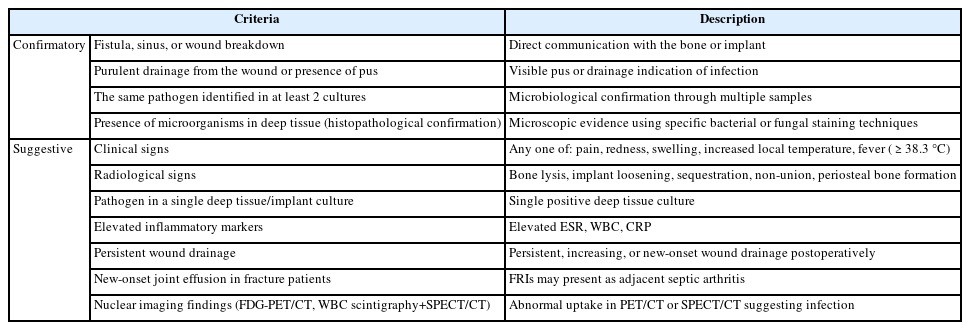
- Fracture-related infections are challenging complications in orthopedic trauma that often require prolonged treatment and impose a significant healthcare burden. Accurate diagnosis and effective prevention strategies are essential for minimizing their occurrence. A recent international consensus has established standardized diagnostic criteria based on clinical, microbiological, radiological, and histopathological findings. Prevention is the top priority and involves a thorough preoperative risk assessment, along with glycemic control, nutritional optimization, and management of comorbidities, as well as intraoperative and postoperative measures such as appropriate antibiotic prophylaxis, surgical site antisepsis, and meticulous wound care. A multidisciplinary approach involving orthopedic surgeons, infectious disease specialists, and microbiologists is crucial for successfully reducing the burden of fracture-related infections.
-
Citations
Citations to this article as recorded by
- Incidence and risk factors of postoperative infection after wrist arthroscopy: an 11-year nationwide population-based cohort study in South Korea
Jisu Park, Hyunsun Lim, SeongJu Choi, Jin Rok Oh, Jun-Ku Lee
Orthopaedics & Traumatology: Surgery & Research.2026; : 104771. CrossRef - Clinical impact of scapular stress fracture after reverse total shoulder arthroplasty: a single-center propensity score–matchedanalysis
By Chul-Hyun Cho, Hyuk-Joon Sohn, Du-Han Kim
Journal of Shoulder and Elbow Surgery.2026;[Epub] CrossRef - Personalized Approaches to Diagnostic and Therapeutic Strategies in Periprosthetic Fracture-Related Infections (PFRIs): Case Series and Literature Review
Marianna Faggiani, Marco Zugnoni, Matteo Olivero, Salvatore Risitano, Giuseppe Malizia, Silvia Scabini, Marcello Capella, Stefano Artiaco, Simone Sanfilippo, Alessandro Massè
Journal of Personalized Medicine.2025; 15(12): 576. CrossRef - Pathogen-Specific Risk for Iterative Surgical Debridement in Orthopedic Infections: A Prospective Multicohort Analysis
Flamur Zendeli, Anna Jędrusik, Raymond O. Schaefer, David Albrecht, Michael Betz, Felix W. A. Waibel, Tanja Gröber, Nathalie Kühne, Sören Könneker, İlker Uçkay
Journal of Clinical Medicine.2025; 14(24): 8750. CrossRef
- Incidence and risk factors of postoperative infection after wrist arthroscopy: an 11-year nationwide population-based cohort study in South Korea
- 12,898 View
- 565 Download
- 4 Crossref
 First
First Prev
Prev


